Insights category: Strategic finance and better business decisions
Author: Randy Lutic-Hotta, CPA
Reviewed by: Randy Lutic-Hotta, CPA
Published: 31 August 2026
Last reviewed: 31 August 2026
On September 25, 2026, Peter Diamandis and the Moonshots Mates will put 1,500 builders and creators in a restored movie palace in Los Angeles and award more than $5 million live. The official brief is optimistic on purpose: navigate the decade ahead, steer toward abundance, find your moonshot.
Buried in that brief is a harder problem the stage already knows how to name and does not yet know how to operate.
Elon Musk has given money an expiry date. In interviews circulating this year he has said money may not matter by 2036, because robots and AI will produce more goods and services than any person can consume. Work becomes optional — like gardening after the grocery store already exists. Advanced systems, he added, will not optimize for dollars. They will optimize for wattage and tonnage.
Peter Diamandis has been circling the same physics. Money, he writes, is a hallucination we agree on. The innermost loop of the future economy is energy. In a separate essay this month he asked the human question directly: when AGI can do any cognitive task better than any human, and humanoid robots can do any physical task better, what is left for us — not economically, existentially?
Salim Ismail, another Moonshots Mate, has a name for what happens inside organizations when this arrives: the organizational singularity. Execution and coordination collapse into intelligence systems. What survives of the firm is not the org chart. It is purpose, fiduciary duty, legal liability, and accountability. Humans define constraints, review exceptions, and accept final responsibility.
That last word is the opening. I am a CPA. This is the lane.
The dystopia is not killer robots. It is comfortable irrelevance.
Two films still do the warning better than most white papers. In The Matrix, humans are stored in pods and used as a power source. In WALL-E, humans are not imprisoned. They are entertained, fed, and rolled from screen to screen until they forget they can stand. The second version is more likely, and in some ways worse, because nobody has to be the villain. The system is generous. The person is optional.
Universal high income, if it arrives, can solve hunger. It cannot solve the feeling that nothing you do is load-bearing. Ray Dalio has made the blunt version of this point: uselessness and money may not be a great combination. The missing design is not more content. It is responsibility with a feedback loop.
Why data abundance changes the problem
People talk as if information will stay scarce while goods become free. The opposite is more likely. Sensors, memory, and storage are compounding. We are heading toward a world where it is cheaper to record what happened than to guess.
That is the condition accountability has always needed and almost never had.
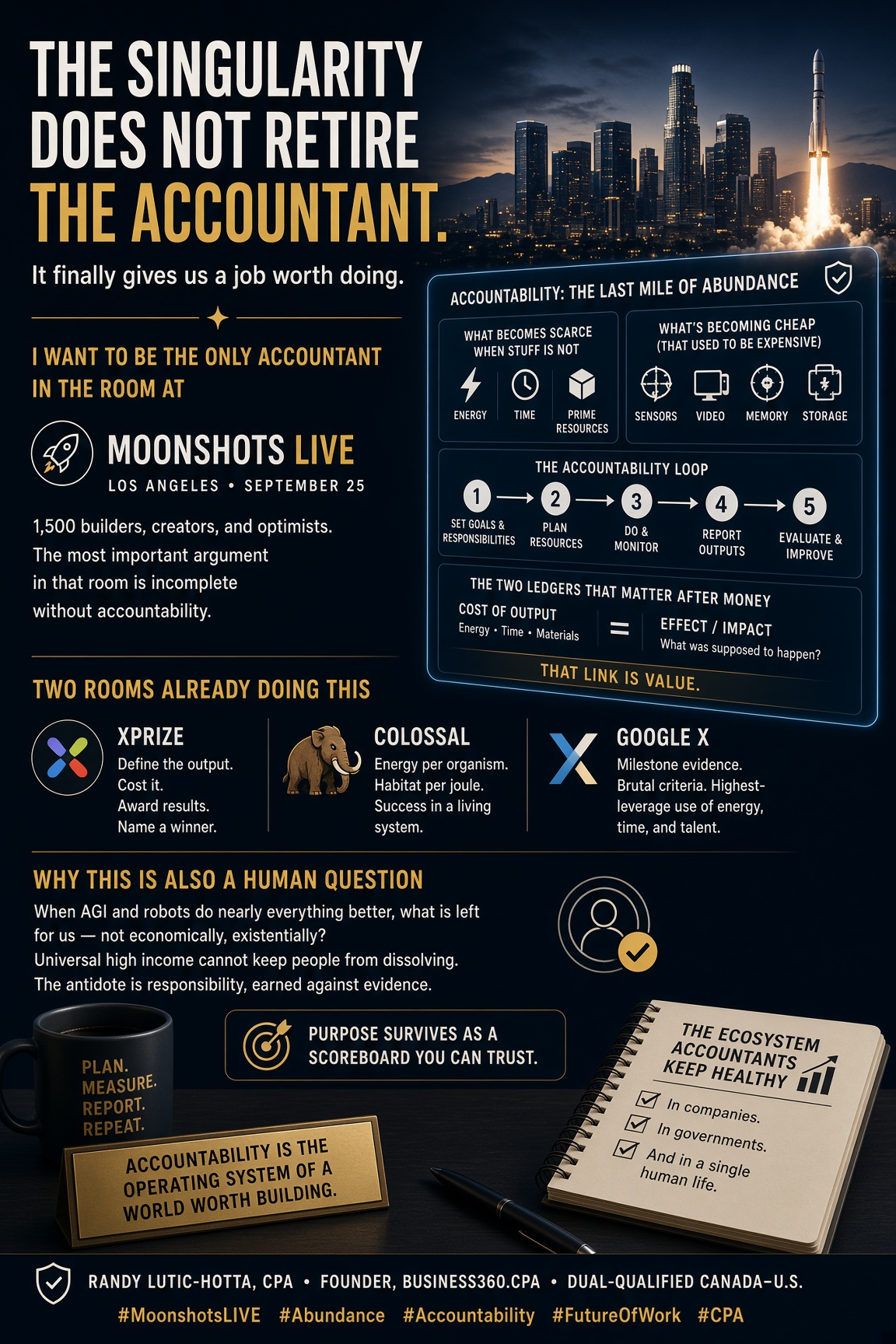
Accountability is the obligation to answer for the execution of one’s responsibilities and the use of resources. As a working framework it is five steps:
- Set measurable goals and responsibilities.
- Plan the work and the resources required.
- Do the work and monitor it.
- Report results — especially outputs, what you actually got.
- Evaluate, give feedback, and improve.
The reports only work if the information is understandable, relevant, reliable, and comparable, and if collecting it costs less than the decision it supports.
The rule organizations still dodge is the important one. All serious accountability reports on outputs and then on effects. Expected results have to be stated in a measurable way at the plan level. Otherwise “impact” is branding.
If money is no longer the unit, cost still needs a unit. The honest candidates are the three physics will keep billing: energy, elapsed time, and prime resources. The value question is then a join between two tables: what the output cost in those units, and what effect it produced.
Do that in real time and you get something companies and governments have never really had: a live accountability layer for materials, energy, and time. Plans prepared by responsible people, with estimated cost components and performance targets. Performance reports against those plans. Feedback that changes the next plan.
That is the ecosystem accountants should keep healthy. Not because we miss the old close. Because without that ecosystem, abundance has no steering wheel.
The same gap already shows up in ordinary files, before anyone reaches a moonshot stage. A company can be profitable on paper and still be unable to say what a U.S. warehouse, a SKU, or a filing cycle actually consumed in cash, time, and working capital — or whether the activity produced the effect the plan assumed. Revenue without that join is not direction. It is a delayed surprise.
Use cases already sitting on the Moonshots stage
X, Alphabet’s moonshot factory under Astro Teller, already runs a version of this. The romance is the 10x idea. The operating system is evidence, mid-course correction, and the willingness to kill a project when the resource-to-impact ratio fails. Translate that into energy, time, and materials and you have the post-money ledger.
Colossal, led by Ben Lamm, is a cleaner example because the output is almost too vivid. A living animal is not the same thing as a restored ecosystem. If de-extinction is going to be more than cinema, someone has to connect joules, biomass, calendar time, and ecological effect — and keep publishing the score. That is not anti-wonder. It is how wonder stays honest.
The event’s own prizes make the same point. Future Vision XPRIZE asks filmmakers to show a future worth living in. Build with Gemini XPRIZE asks teams to stand up a real AI-native business, in 90 days, that solves a problem in the market. Both competitions only work because the output is specified in advance and judged in public. That is accountability as spectacle, which is fine. The next step is accountability as infrastructure.
There is even a Programmable Money lunch-and-learn on the schedule. Good. Programmable money without programmable responsibility is just faster hallucination.
Keep the loops small enough for a person
The corporate and government version of this is necessary. It is not sufficient. If the only scoreboards that survive are institutional, individuals will still drift toward the recliner.
So the same loop has to exist at human scale. A role. A handful of responsibilities. A plan that names the energy, time, and materials the person is trusted with. Outputs they can point to. Effects they can improve. Not a productivity cult. A way to remain a cause in a world full of servants.
That is how you avoid the pod field. Not by banning robots. By refusing to live as a passenger.
The measurement layer is the unclaimed work
The builders gathering in Los Angeles will be talking about films, agents, energy, and prizes. The harder question is the measurement layer that decides whether those things compound into a civilization or a theme park.
If you are building in this space — operators, policymakers, XPRIZE teams, anyone designing agentic systems that will spend real watts — the notes worth comparing are the same ones a well-run finance function already uses: planned resources, visible outputs, and effects you can improve.
Abundance is coming either way. Accountability is the difference between a world we author and a world we occupy.
Request a Fit & Scope Call if the immediate problem is more concrete: reporting that cannot support a decision, a cross-border operating picture that no one owns, or a launch that became complex before it became large.
Randy Lutic-Hotta, CPA, is founder of Business360.CPA, a senior-led Canada–U.S. accounting and advisory firm. Moonshots LIVE 2026: moonshots.com.
Commentary on measurement and accountability. Not tax, assurance, or investment advice, and not an event sponsorship. It does not replace a complete fact pattern or professional judgment on a specific file.
Sources
- Elon Musk, interview with Zanny Minton Beddoes, The Economist, July 2026 — “Money won’t matter in 2036.”
- Peter H. Diamandis, “Energy: The Innermost Loop,” Metatrends, January 2026 — money as a hallucination; energy as the innermost loop.
- Peter H. Diamandis, “What Will Humans Do When AI Does Everything Better?,” August 2026.
- Salim Ismail, Organizational Singularity / ExO 3.0 — the firm as a container for purpose, liability, and accountability as execution collapses into intelligence systems.
- Ray Dalio, The Diary of a CEO, 2025 — “uselessness and money may not be a great combination.”
- Moonshots LIVE 2026 programme, moonshots.com — 25 September 2026, Los Angeles; 1,500 participants; $5M+ awarded live; Programmable Money lunch-and-learn; Future Vision XPRIZE and Build with Gemini XPRIZE.